Imagine receiving that official summons for jury duty. For many, it’s a civic responsibility they’re ready to embrace. However, for others, the timing can present a serious financial dilemma, turning a civic duty into a source of stress. This often leads to questions about how to request an excusal effectively.
Navigating the court system while facing economic strain can feel overwhelming. Missing work for an extended period, especially for those in hourly jobs or self-employment, can severely impact household income and stability. Understanding your options and presenting your case clearly is crucial in these situations.
This article will guide you through the process of requesting an exemption or deferral due to financial hardship. We will explore what constitutes legitimate hardship, provide a detailed financial hardship jury duty excuse template, and offer practical tips to ensure your request is well-received by the court.
Understanding Legitimate Financial Hardship for Jury Service
Serving on a jury is a cornerstone of the justice system. Courts generally expect citizens to fulfill this obligation. However, they also recognize that life circumstances can make it genuinely impossible for some individuals. Financial hardship is one of the most common and valid reasons for requesting an excusal or deferral.
True financial hardship means that jury service would cause severe economic distress for you or your dependents. This isn’t just about losing a few days’ pay; it’s about facing significant, unrecoverable losses that threaten your ability to meet essential living expenses. Courts will assess the severity of your situation very carefully.
Defining Economic Distress for Jury Duty
Economic distress often involves situations where your employer does not compensate you for jury duty leave. For instance, hourly wage earners may find their income drastically reduced, making it difficult to pay rent, utilities, or buy groceries. Many individuals simply cannot afford to miss work without jeopardizing their basic needs.
Self-employed individuals, small business owners, or freelancers also face unique challenges. Their income is directly tied to their active work hours. Prolonged absence can result in lost contracts, clients, and revenue, which can be impossible to recover. This direct impact on their livelihood constitutes significant hardship.
Gathering Documentation to Support Your Claim
To effectively demonstrate financial hardship, you will need more than just a statement. Courts typically require supporting documentation to corroborate your claims. This helps judges or court clerks make an informed decision and verifies the legitimacy of your request.
Relevant documents might include recent pay stubs showing hourly wages, letters from employers stating non-payment for jury service, or bank statements demonstrating limited savings. For the self-employed, tax returns, profit and loss statements, or invoices proving lost income can be highly effective evidence. It’s essential to gather everything that paints a clear picture of your financial situation.
Crafting Your Effective Jury Duty Exemption Letter
Once you understand what constitutes financial hardship, the next step is to communicate your situation clearly and respectfully to the court. A well-structured and professional letter is your best tool for this. This is where a robust financial hardship jury duty excuse template becomes incredibly valuable. It helps ensure you include all necessary details and maintain a formal tone.
A compelling letter explains your circumstances without sounding demanding or entitled. It should be factual, concise, and focused on the undeniable economic impact jury service would have. Remember, you are requesting an accommodation, not making a demand.
Key Elements of a Strong Hardship Request Letter
Your letter should begin with your personal information and the court’s details, followed by your juror identification number. Clearly state that you are requesting an excusal or deferral due to financial hardship. The body of the letter needs to elaborate on your specific situation, explaining how jury service would cause undue economic burden.
Be precise about your employment situation, whether you are paid hourly, self-employed, or unable to find childcare without significant expense. Detail the specific financial consequences, such as inability to pay rent, loss of crucial business income, or risk of job termination. Always offer to provide supporting documentation to back up your claims.
A Comprehensive Financial Hardship Jury Duty Excuse Template
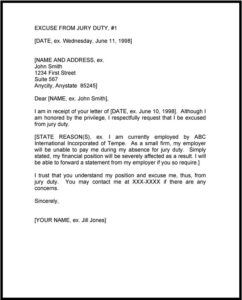
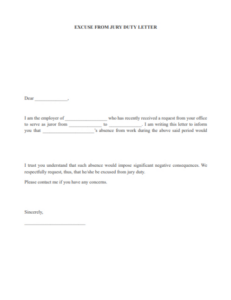
Here is a sample structure you can adapt to create your personal request. Remember to fill in the bracketed information with your specific details. This template provides a clear framework, allowing you to focus on the specifics of your unique financial situation.
-
- Your Name: [Your Full Name]
- Your Address: [Your Street Address, City, State, Zip Code]
- Your Phone Number: [Your Phone Number]
- Your Email: [Your Email Address]
- Date: [Current Date]
-
- Clerk of the Court: [Clerk’s Name, if known, or “Jury Commissioner”]
- Court Address: [Court’s Street Address, City, State, Zip Code]
-
- Subject: Request for Excusal/Deferral from Jury Service – Juror ID: [Your Juror ID Number]
-
- Dear Jury Commissioner / Clerk of the Court,
-
- I am writing to respectfully request an excusal or deferral from jury service for which I have been summoned for [Start Date of Jury Service]. My Juror Identification Number is [Your Juror ID Number].
-
- While I understand and respect the importance of civic duty, serving at this time would cause severe and unrecoverable financial hardship for myself and my dependents.
-
- [**Explain your employment situation here.** Examples: “I am an hourly employee, and my employer does not provide paid leave for jury duty. Missing [Number] weeks/days of work would result in a significant loss of income, approximately $[Amount], making it impossible to cover essential living expenses suchs as rent, utilities, and groceries.”]
-
- [**OR: If self-employed/small business owner.** Example: “As a self-employed [Your Profession, e.g., freelance graphic designer], my income is solely dependent on my active work hours and client projects. A prolonged absence would result in the loss of crucial client contracts and revenue, estimated at $[Amount], which would severely jeopardize the viability of my business and my ability to support my family.”]
-
- [**Add any other specific financial burdens.** Examples: “I am solely responsible for childcare costs of $[Amount] per week, which I cannot afford if my income is reduced,” or “I am currently undergoing significant medical expenses not covered by insurance.”]
-
- I have attached supporting documentation, including [list documents, e.g., recent pay stubs, a letter from my employer, bank statements, or tax returns], to substantiate my claim of financial hardship.
-
- I would be grateful if you would consider my request for an excusal or deferral. I am willing to serve at a future date when my financial situation is more stable.
-
- Thank you for your time and consideration of this matter.
- Sincerely,
- [Your Typed Full Name]
Remember to customize the bracketed sections and provide as much detail as possible. Attach all supporting documents, clearly labeled. Sending your request via certified mail provides proof of delivery, which is always a good practice. This **financial hardship jury duty excuse template** is designed to give you the best possible start.
Submitting Your Request and Understanding Court Responses
Once you have meticulously prepared your letter and gathered all necessary documentation, the next crucial step is submitting your request. Following the correct procedure ensures your plea for a jury duty deferral or exemption reaches the right people in a timely manner. Each court may have slightly different submission guidelines, so always double-check your summons for specific instructions.
Most courts prefer written requests for excusal, often mailed or sometimes submitted online through a juror portal. Make sure to send your request well in advance of your scheduled jury service date. This allows ample time for the court to review your case and respond, preventing last-minute complications.
Best Practices for Submission and Follow-Up
Always send your hardship request via certified mail with a return receipt requested. This provides irrefutable proof that your letter was sent and received by the court. Keep a copy of your letter and all attached documents for your records. This ensures you have a full reference if you need to follow up or if there are any discrepancies.
If you do not receive a response within a reasonable timeframe (e.g., within 7-10 business days before your service date), it is appropriate to follow up. You can usually call the Clerk of Courts or the Jury Commissioner’s office directly. Be polite and have your juror ID number and a copy of your submitted request handy. Persistence, coupled with respect, can be very effective.
Possible Outcomes of Your Hardship Request
There are generally three possible outcomes when you submit a request for excusal based on financial hardship. The most favorable outcome is a full excusal, meaning you are completely relieved of your jury service obligation. This usually occurs when the court finds your evidence of severe economic hardship to be compelling and undeniable.
Another common outcome is a deferral. This means your jury service is postponed to a later date, giving you time to stabilize your financial situation. Courts often offer deferrals, allowing you to fulfill your civic duty when it poses less of a burden. The third outcome is denial, in which case you will be expected to report for jury duty as summoned. If denied, you might have one last chance to explain your situation in person to the judge if you are selected for a jury panel.
Navigating jury duty with significant financial challenges can be a daunting prospect. However, understanding your rights and the proper channels for communication can make a substantial difference. By carefully documenting your situation and presenting a clear, respectful request, you significantly increase your chances of a favorable outcome.
Remember that courts are generally understanding of genuine financial hardship. Utilizing a well-structured financial hardship jury duty excuse template and backing it with solid evidence empowers you to manage this civic responsibility without jeopardizing your economic stability. Take the time to prepare thoroughly, and approach the process with diligence and respect.